Teaching
Computational Methods in Physics
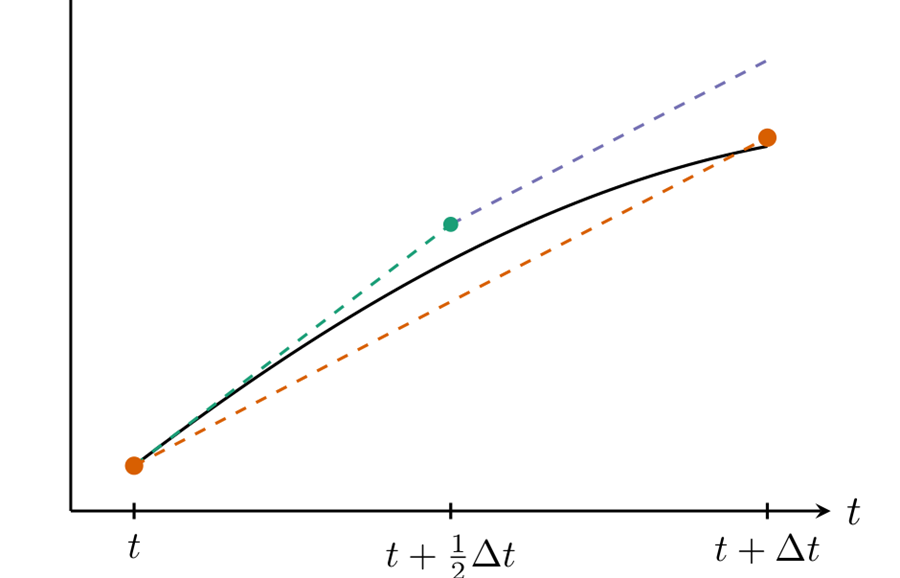
A project-centered introduction to modeling and simulating physical systems with Python. Topics will be drawn from population dynamics, oscillators and chaos, orbital mechanics and scattering, data analysis and fitting, diffusion and waves, quantum and statistical physics, and quantum computing. Emphasis is on implementing models, using computation to understand the underlying physics, and presenting results effectively.
Mathematical Methods in Physics and Engineering
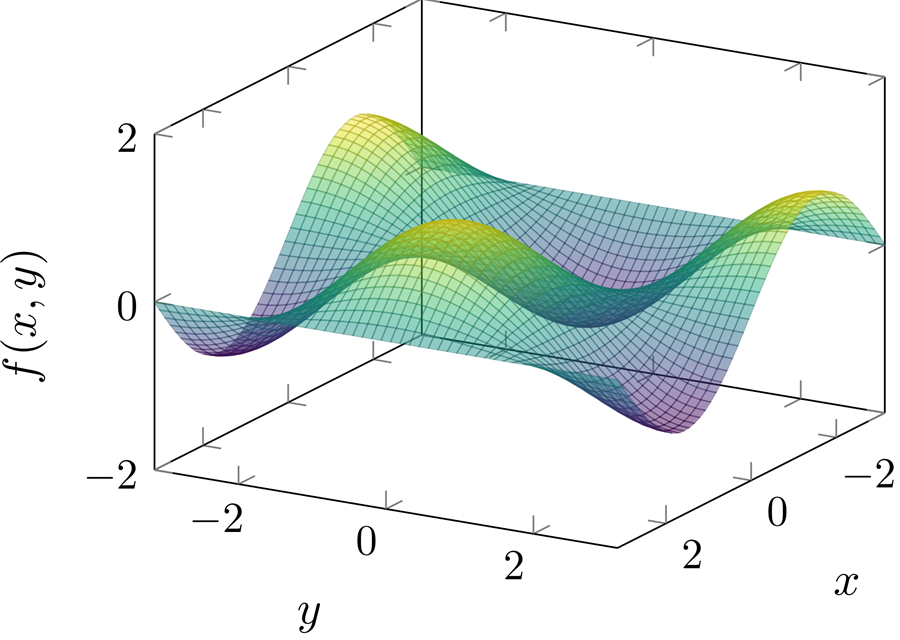
An introduction to the mathematical tools used across the physical sciences. Topics include complex numbers; power series; vectors and matrices; ordinary differential equations; functions as vectors; curve fitting; Fourier series and transforms; partial derivatives; and partial differential equations. Emphasis is on physical interpretation and using these tools to solve problems in physics. Applications include oscillations and waves, diffraction and optics, electromagnetic fields, heat flow and diffusion, and quantum mechanics.
Mathematical and Computational Methods in Physics
.png)
An exploration of mathematical and computational techniques used to solve problems in physics. Topics include basic programming and data analysis, statistics, curve fitting and minimization, numerical solutions to differential equations, wave equations, diffusion equations, complex numbers, and Fourier analysis.
Introductory Physics I with Lab: Forces and Energy

A calculus-based introduction to the concepts and principles of mechanics, emphasizing translational and rotational kinematics and dynamics, work and energy, conservation laws, and gravitation. Hands-on exploration of physical systems using computer-interfaced laboratory equipment and modeling techniques are used to illustrate physical principles.
General Relativity I

An elementary introduction to general relativity, the basic physical concepts of its observational implications, and the new insights that it provides into the nature of space time, and the structure of the universe. Familiarity with special relativity and electromagnetism is assumed. The lectures review Newtonian gravitation, tensor calculus and continuum physics in special relativity, physics in curved space time and the Einstein field equations. This suffices for an account of simple applications to planetary motion, the bending of light and the existence of black holes.